

The Single-Trunk Pavilion
Single-Trunk Money Tree
Pachira species
Loading this page…
Return homePlease wait while the next page arrives.
An unbraided trunk supports a canopy of glossy leaflet fans. Keep this tropical tree warm, evenly lit and in an airy mix that drains after watering.
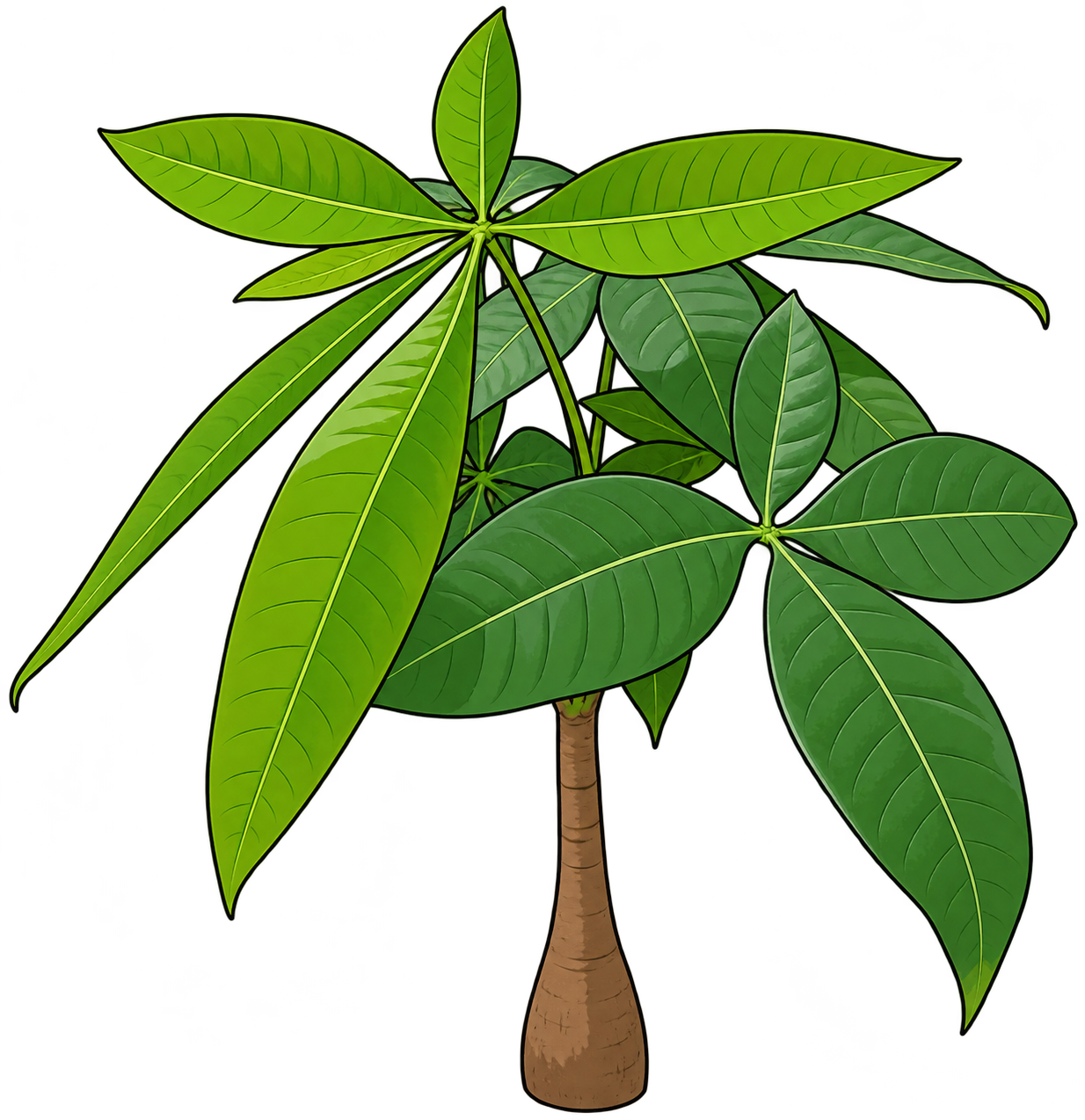
Source photograph · Mila’s Exotic Plants and Curiosities / Luminary Oddities; photographer not separately credited
Reference photograph from the owner’s shop listing; no public open license is stated.
Single-Trunk Money Tree is a tropical Pachira grown for its upright trunk and palmate canopy. Its unbraided shape allows the branching structure to remain visible as the tree develops. [1]
Choose a bright position with filtered light. Screen intense window sun, especially after a move; money-tree foliage can scorch under abrupt strong exposure. [2]
Partial shade is also documented for Pachira glabra. Watch new growth and move toward brighter filtered light if the canopy becomes sparse rather than placing the pot in a dark corner. [5]
Let the surface begin to lose moisture, then check below it before watering. Keep the root ball lightly moist without holding it in standing water. Leaf drop can follow either a dried root ball or roots kept too wet. [2]
Water evenly until excess drains; empty the saucer. Use mix moisture and pot weight to set the next interval instead of a fixed weekly schedule. [3]
Use an open houseplant mix with moisture-holding organic material and coarse components that preserve air spaces. A nursery pot with drainage can sit inside a decorative cover, provided runoff is emptied. [3]
Keep the tree in steady indoor warmth, away from cold glass and heater drafts. Humid air supports tropical foliage; a maintained humidifier is more effective than repeatedly misting leaves. [3]
Feed a healthy, actively growing tree with a complete houseplant fertilizer at its labeled dilution. Check whether the potting mix already contains feed, and reduce or pause applications during slow growth. [6]
Repot as active growth begins when roots crowd the container, drainage deteriorates or the tree becomes unstable. Increase the pot modestly; extra wet mix around a small root system slows drying. [7]
Lift out the root ball gently, loosen tight circling roots and replace exhausted mix. Keep the trunk at its previous depth, water in, and let the container drain before replacing its cover pot. [8]
Semi-ripe stem cuttings and air layering are documented money-tree methods. For a cutting, select healthy growth with a firm base and keep its orientation clear. [1]
Remove lower leaves, cut below a node and insert the base in fresh rooting medium. Keep warm in bright indirect light under a ventilated humidity cover. Pot on only after roots develop, then uncover gradually. [9]
Shorten overly long shoots during active spring growth to manage height and encourage a balanced canopy. Make clean cuts above suitable growth rather than removing a large part of the tree at once. [1]
For a bonsai starter, begin by growing a healthy trunk and canopy. Delay intensive root reduction until you have a training plan and a vigorous plant. [10]
Yellowing or leaf drop: check root moisture, blocked drainage and recent temperature changes first. A soft trunk base or continuing wilt in wet mix warrants prompt horticultural assessment. [2]
Cottony clusters, hard bumps or fine webbing: inspect leaf undersides and stem joints. Separate the plant and identify the pest before choosing a labeled treatment. [11]
Keep this ornamental tree, fallen leaves and pruning waste away from pets. Do not offer its plant parts or seeds as food. [12]
Prevent children chewing plants; label pots. [13]
Human poisoning (U.S.): 1-800-222-1222. Medical emergencies: 911. [14]
Pet poisoning: veterinarian; ASPCA 888-426-4435 (consultation fee). [15]
A single trunk and braided trunks are different presentations of a money tree, not different watering categories. The palmate fans distinguish this tree from plants called money plants with individual round leaves. [1]
Royal Horticultural Society
Accessed October 5, 2026
NC State Extension
Accessed October 5, 2026
Purdue University Cooperative Extension Service
Accessed October 5, 2026 · Updated: Reviewed May 2001
National Capital Poison Center
Accessed October 5, 2026
Singapore National Parks Board
Accessed October 5, 2026 · Updated: 2026-05-05
University of New Hampshire Extension
Accessed October 5, 2026 · Publisher date: 2018-03-08
University of Minnesota Extension
Accessed October 5, 2026 · Updated: Reviewed 2026
Clemson Cooperative Extension
Accessed October 5, 2026 · Publisher date: 1999-09-21
Royal Horticultural Society
Accessed October 5, 2026
Royal Horticultural Society
Accessed October 5, 2026
University of Missouri Extension
Accessed October 5, 2026 · Publisher date: September 2017 · Updated: Reviewed April 2022
Pet Poison Helpline
Accessed October 5, 2026
Children’s Hospital of Philadelphia
Accessed October 5, 2026 · Publisher date: 2019-07-08
National Capital Poison Center
Accessed October 5, 2026
ASPCA Poison Control
Accessed October 5, 2026