

The Lacquered Bough
Burgundy Rubber Tree
Ficus elastica ‘Burgundy’
Loading this page…
Return homePlease wait while the next page arrives.
Broad, glossy leaves carry deep-green and burgundy tones along a sculptural upright stem. Give this rubber tree bright indirect light, steady warmth and a freely draining root zone.
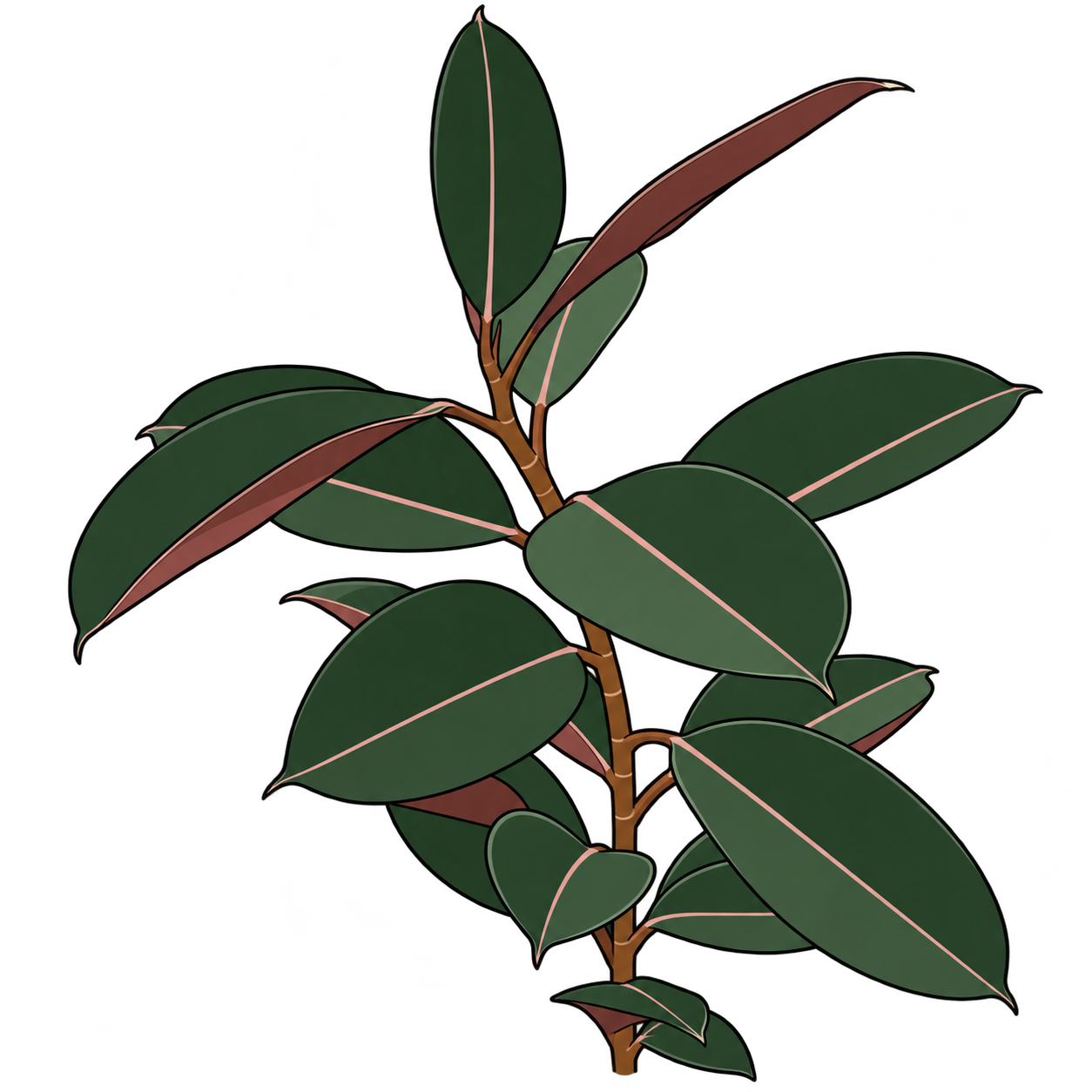
Source photograph · Mila’s Exotic Plants owner catalogue; individual photographer uncredited
Reference photograph from the owner’s shop listing; no public open license is stated.
Give the plant bright filtered or indirect sunlight indoors. [13]
During active growth, feed monthly with a high-nitrogen fertilizer suited to foliage houseplants, following its label directions. [13]
Semi-ripe stem cuttings and air layering are supported ways to propagate rubber trees. [13]
For a cutting, select healthy growth with a firm base. Cut below a leaf node, remove lower leaves and insert the prepared stem into draining cutting compost. [15]
Keep cuttings warm, in bright indirect light and in moist medium. Ventilate covers and remove decaying material. [15]
Air layering roots a stem while it stays attached. Remove a narrow ring of bark and scrape away the remaining soft tissue beneath it. Wrap the exposed area in damp sphagnum moss and enclose it in secured clear plastic. After a good root system develops, sever below the rooted area. Remove the plastic and ties before potting into draining mix. [16]
Assess root moisture and drainage before changing the routine. [5]
Inspect pest signs closely before choosing a treatment. [6]
Rubber-tree sap can irritate a pet’s mouth and stomach. Keep plants, fallen leaves and cuttings away from pets that chew them. [17]
Wear gloves when pruning; the milky sap can irritate skin. [14]
For suspected poisoning or signs of illness, contact your veterinarian or ASPCA Poison Control at 888-426-4435. Provide the botanical name. [7]
Keep plants, cuttings and loose potting material beyond young children’s reach. Keep the botanical name with the pot. [8]
For human plant ingestion in the United States, call Poison Control at 1-800-222-1222. Elsewhere, contact your local poison service. Call emergency services for breathing difficulty, seizures, collapse or inability to awaken. [9]
University of Maryland Extension
Accessed October 5, 2026 · Updated: 2023-03-10
University of Maryland Extension
Accessed October 5, 2026 · Updated: 2023-03-10
University of Illinois Extension
Accessed October 5, 2026
Iowa State University Extension and Outreach
Accessed October 5, 2026 · Updated: Last reviewed October 2023
Iowa State University Extension and Outreach
Accessed October 5, 2026 · Updated: Last reviewed January 2024
Iowa State University Extension and Outreach
Accessed October 5, 2026 · Updated: Last reviewed January 2024
ASPCA Poison Control
Accessed October 5, 2026
National Capital Poison Center
Accessed October 5, 2026
National Capital Poison Center
Accessed October 5, 2026
Royal Botanic Gardens, Kew
Accessed October 5, 2026
NC State Extension
Accessed October 5, 2026
University of Missouri - David Trinklein
Accessed October 5, 2026 · Publisher date: 2026-02-05 · Updated: 2026-02-04
Royal Horticultural Society
Accessed October 5, 2026
Royal Horticultural Society
Accessed October 5, 2026
Royal Horticultural Society
Accessed October 5, 2026
Iowa State University Extension and Outreach
Accessed October 5, 2026 · Updated: 2022-03-04
Pet Poison Helpline
Accessed October 5, 2026
Royal Botanic Gardens, Kew
Accessed October 5, 2026